00:05
Davion Ford
Welcome to Better Cities by Design, a podcast brought to you by Arcadis where we talk to changemakers, who are working to make our cities better places for people to live, work and play. I'm your host Davion Ford. I’m your host Davion Ford. This week, we’re going to Antwerp in Belgium for a conversation with Tom Meeuws, Vice mayor of the city. We’ll talk to Tom about Antwerp's ambitious plan to become carbon neutral by 2050 and cutting emissions in half by 2030. We’ll also explore how a sustainable district heating network will help them achieve this goal.
00:49
Davion Ford
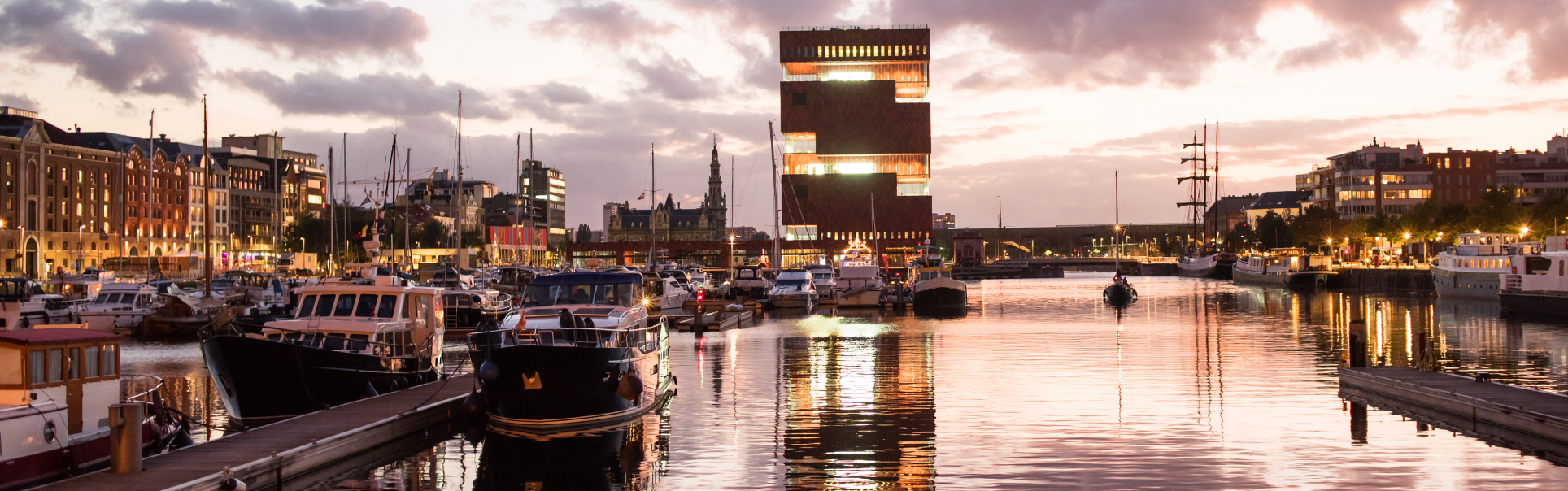
Nestled on the River Scheldt with history dating back to the Middle Ages, Antwerp, Belgium, is a city that's making waves in the battle against climate change. This bustling metropolis has not only been a center of commerce for centuries, but it has also shaped the cultural tapestry of the region. Antwerp played a significant role in the life and work of Flemish artist and diplomat Peter Paul Rubens, one of the most renowned Baroque painters. In fact, Antwerp has long been a bastion of artistic expression and creativity. The majestic cathedral of Our Lady housing some of Ruben's masterpieces stands as a testament to the city's artistic legacy. But Antwerp is not a city bound by the past. It's a vibrant, thriving city which constantly redefines itself for the future. It's a place where history and modernity meet. But Antwerp's cultural significance is only part of the story. Today, it's a city that stands at the forefront of an environmental revolution. Antwerp has set ambitious climate goals, striving to cut emissions in half by 2030 and become completely climate neutral by 2050. And then there was last year. 2023 was a year marked by extreme climate events, which led some skeptics to doubt whether it’s possible for cities like Antwerp to achieve their climate goals. One factor which may be the key to solving Antwerp’s climate challenges is its massive port. The Port of Antwerp-Bruges is Europe's second-largest port, a colossal entity that shapes not only the city but the entire nation. It's an intricate web of shipping containers, cargo ships, and logistics that is active day and night. Also in the port, you will find the largest integrated chemical cluster in Europe, with companies like BASF, ExxonMobil, TotalEnergies and 3M having major operations there. And surprisingly, it’s this chemical cluster that may help Antwerp pave the way to climate neutrality. Here’s Arcadis’ Solution Lead Energy Transition, Hendrik-Jan Steeman.
03:04
Hendrik-Jan Steeman
The city of Antwerp is blessed with a huge potential of waste heat from the industry in the port which can be used to decarbonize the heating of the existing buildings in the city center. The city now also has a detailed roadmap on the roll out of a city-wide district heating program, which was drafted in consultation with all stakeholders. The scale of this program makes it unique in Belgium: this is a program that puts forward a consistent and realistic vision to decarbonize the city center. I sincerely hope that in 2050 we will look back at this program and see that the foresight of the city to start now with the decarbonization program, was what made us achieve climate neutrality.
03:47
Davion Ford
To find out more about this innovative project and Antwerp’s climate change efforts, I’m really happy to welcome Vice Mayor Tom Meeuws to the program. Hello, Tom, welcome to Better Cities by Design.
Tom Meeuws
Hello, Davion.
Davion Ford
So Tom, can you introduce yourself and tell our listeners a bit about Antwerp and what made you decide to go into politics?
04:15
Tom Meeuws
Yeah, I'd love to. A good question to start with. I'm the Vice Mayor of the City of Antwerp and I'm responsible for social affairs, poverty reduction, social economy and environmental affairs, climate and energy. Over the past 20 years, my professional experience was in the city itself. I was staff member to the city's labor market policy, chief of staff for the aldermen for community development, that well, 50 years ago. And then I used to work as a director of the public mobility organization, public transport organization in Antwerp. Earlier on, I was a policy adviser on the labor markets and sustainable development issues for the Federal Planning Bureau of the Kingdom of Belgium. Talking about Antwerp itself, Antwerp is a port city with 530,000 inhabitants, what we call a pocket sized metropolis.
05:18
Davion Ford
Okay, Tom. So 2023 was a particularly striking year when it came to climate change impacts, and many folks out there are thinking it's no longer possible for a city like Antwerp to actually meet those climate goals that you guys have made. So tell me how you're going to prove them wrong.
05:35
Tom Meeuws
We really have to leave the doom and gloom atmosphere that's hanging around the climate debate nowadays. So we're very proud in Antwerp, to announce that we overachieved even our intermediate targets in the Covenant of Mayors. We committed to reduce our emissions by 20% by the year 2020, and compared to the base year of 2005. So the latest emissions inventory in Antwerp shows that by 2020, so three years ago, we had already reduced our emissions by 30.4%, far better than we previously did foresee. And indeed, we're monitoring our policy measures day by day, in order to reach the proposed target of 50-55%, and fully aligned with the UK emissions reductions. So we want to reduce our emissions by 50-55% in 2030. And, and we constantly monitor that, but the starting point is here, really believe that you can reach your goals. It's kind of the mission/ambition of the famous American Italian, Mariana Mazzucato. And it's like Kennedy said, in the beginning of the 60s: “By the end of the decade, we will put a man on the moon.” They joined all efforts. They broke all silos in, in a governmental administration, America. And by the end of the decades, yes, they will go onto the moon. And so in that kind of mission state economy you believe in a clear mission. And climates, reducing carbon emissions is really a mission. So if you do that, you monitor your results. And then you keep on going on track to reach your ambitions. And it's that optimistic of that also realistic message that we have to spread out, day by day.
07:46
Davion Ford
Okay, so when we look at the heating network, that you were the district heating network that you were just talking about. This is also obviously a project that we're really proud of here at Arcadis as well. But a major project like this in a really busy city, like Antwerp has the potential to be really disruptive for the folks who are living and working there. So how are we pulling off this work without upending daily life for residents? And also this bit around controlling costs?
08:19
Tom Meeuws
Yeah, what we try to do is to create maximum synergies with other public works and utilities, in order to avoid that the same street we buried open several times in a short period of time. So that's, that's one of the major challenges. Of course, if you talk, if I go into the districts, and I'm touring in a lot of districts of our city, in a lot of neighborhoods of our city. If I talk to people and try to sell our new district heating network, the applause isn't the kind of applause you get when Madonna comes around in the Antwerp concert halls. Because people think, “Oh, well, they will have to cook in a completely other way. I won’t be able to park my car during five years when my street is open for a lot of public works and utility firms working in my area.” So we try to make what we call “work with work.” So, with a city in full renovation, we are completing, for example, our ring road. It's a 10 billion euro big public work. And so, the whole city is a kind of an open wharf. And so, we try to make work with work. And we put in that heat district system, the pipes and the tubes in the ground while doing other works. The second thing we did is with an urban legislation, with an urban regulation, we introduced a price ceiling for families connected to the district heating grid in order to guarantee that they will not pay more than if heated by a gas boiler of individual heat pumps. So there's also that financial incentive and a local, let's say local legislation in order to convince people that they won't pay more than when heating with a gas boiler. And the third thing is, it's all about comfort too. It's all about selling climate measures as it will lift up your comfort, your living experience in your own apartment block. So connecting to the district heating system brings a lot of comfort, we say. A heating substation, heat exchanger takes less space and also less maintenance costs. So we try to convince people more in a psychological way than in a technical way. And we try to avoid too much work on the public domain.
11:03
Davion Ford
Okay, Tom. So I'm curious how you guys decided what steps to take when. So, over the past decade or so, we've seen a lot of initiatives and projects and cities all over the world with really big promises about the sustainability impact of those efforts. And in the end, many of them have not delivered on those promises. What have you done differently there in Antwerp?
11:24
Tom Meeuws
What we do differently is, first of all, accepting that the climate policy and the climate measures we took, let us say the last 20 years, they were too much oriented towards a high income groups expecting them with a large amount of money to invest themselves on an individual basis, invest themselves in energy and climate solutions. Think about, of course, the electric cars, the photovoltaic panels on your rooftops. Most of the time, even subsidized by the government with public taxpayers money. And what you see there is that we risk leaving behind a lot of people, the moderate income groups, and of course, the lower income groups. And so we changed the track, we changed the orientation in Antwerp, as I'm responsible for social affairs and for environmental affairs, we set out our new strategy must be a public driven strategy, where we aim at installing robust and collective systems in water supply or for example, in setting up district heating systems. Every measure that we take must respond to a lot of people, to the many and not the few. And the many means, if you talk about just transition in climate policy, it means always putting forward the low income groups first. That means that we have to look at public funding, or public compensation or public incentives in order to help in the first place those income groups. And we do what we in Western Europe, typical social welfare states, cities always have done. That is we set up robust systems, in which of course, everyone pays taxes, everyone contributes to a social, but nowadays also, an ecological big aim, in which we redistribute the money that is going on in that system. And so, for example, our own federal government, your own federal Belgian government, we love it at the Belgian Federal Government level, to foresee for example, a social telephony heat supply to vulnerable households with the compensation of the heat supplier. In order to set up our district heating system we have to look at the classical tariff system, for example. And we have to adjust that in a social just way. So it's a very important question you asked there. It's constantly bearing in mind that climate policies will only succeed if we don't leave anyone behind. And so every measure that we take must aim at the big figures, at robust collective target groups and always, always taking and putting low income groups in the first place.
15:12
Davion Ford
I know that Antwerp has some very ambitious climate goals, including going Climate Neutral by 2050 and cutting emissions in half by 2030. What are some of the major challenges that Antwerp needs to overcome in order to achieve this?
15:27
Tom Meeuws
The major challenges in Antwerp are the renovation of multi-apartment blocks. That's the first one and the second one is the model shifts in transport. Talking about the first challenge, 70% of Antwerp’s population lives in multi-apartment blocks with in many cases the big problem of split ownership. And that means 60% of the Antwerp people rent a house, aren't landlords, and this makes large scale, energetic renovation very challenging and especially to achieve it in an inclusive, in a social just way. What we try to do on that topic is to incentivize our collective renovation by subsidizing what we call master plans and roadmaps for it with the renovation of those apartment blocks, giving guidance to the whole renovation trajectory and giving grants and cheap loans for renovation to associations of co-owners, what we call it, the association of co-owners is key in realizing our climate reduction goals in renovating multi-apartment blocks. In the last years we benefited from support in this domain. So, looking at how can we renovate multi apartment blocks, we received support from several European projects, the Interact projects, AAA, the burial project, the Sonnet project. To further decarbonize our building stock, we strongly count on the construction, not only the renovation of the multi-blocks itself, but we strongly count also on the construction of a city-wide district heating grids as a weapon of mass reduction, we call it. Our heating system is the weapon of mass reduction. Antwerp has the second largest chemical cluster in the world, just behind Houston. And we want to recover the waste heat in that port area. The waste heat that is now lost in cooling water, cooling towers and chimneys to feed our district heating grid. We call it our weapon of mass reduction, we call it in one slogan, it's the port area can warm up all the residential buildings of the city itself. And so by 2030, 10% of our heat demand will be served by district heating, as in seven years, so that's a lot of work to do. But for me as a Vice Mayor, also responsible for social affairs, to make renewable energy also available for vulnerable families, we're working on kind of innovative measures, like we are establishing now a citizen renewable energy community, wherein we share the power production of our own photovoltaic installations on city buildings with the, let us say, 10,000 vulnerable families in our city. Talking about just shortly, talking about the second major challenge, the modal shift in our transport system. Well, that's quite a challenging thing. We're not counting on heavy mass reduction there. In the heart of Western Europe, in the logistical heart of Western Europe, a lot of our containers coming into our port area go immediately on tracks towards the whole of Europe. So there we count on heavily new investments. Kind of like in the French city way, investments in new tram railways, metro stations and train stations. And of course, we also gain from the shared mobility trends. But so the most important challenge is in the renovation of multi-apartment blocks.
19:37
Davion Ford
Tom, thank you so much for your time. Thanks for joining the show.
19:40
Tom Meeuws
Yeah, I loved to. Yeah, bye bye.
19:42
Davion Ford
That’s all for this episode of the show! We hope you enjoyed our conversation with our guest, Antwerp’s Vice Mayor Tom Meeuws. We are so proud of the work we’re doing with the City of Antwerp on this district heating network and helping the city achieve its climate goals. And thank you for listening and we hope you will stay tuned for our future episodes as we continue to bring change-makers to the table who are driving progress in urban development. And if you haven't already, be sure to subscribe and check out our other episodes. I’m Davion Ford, and you’ve been listening to Better Cities by Design, a podcast brought to you by Arcadis, the world’s leading company delivering sustainable design, engineering, and consultancy solutions for natural and built assets. You can learn more by visiting our website arcadis.com or by following Arcadis on LinkedIn or Facebook. Stay curious, get inspired, and remember, the future belongs to those who dare to make a difference in the cities we call home.